
On Gardens
Borrowed Scenery
Shakkei, raked gravel, and the discipline of a garden built for one seat
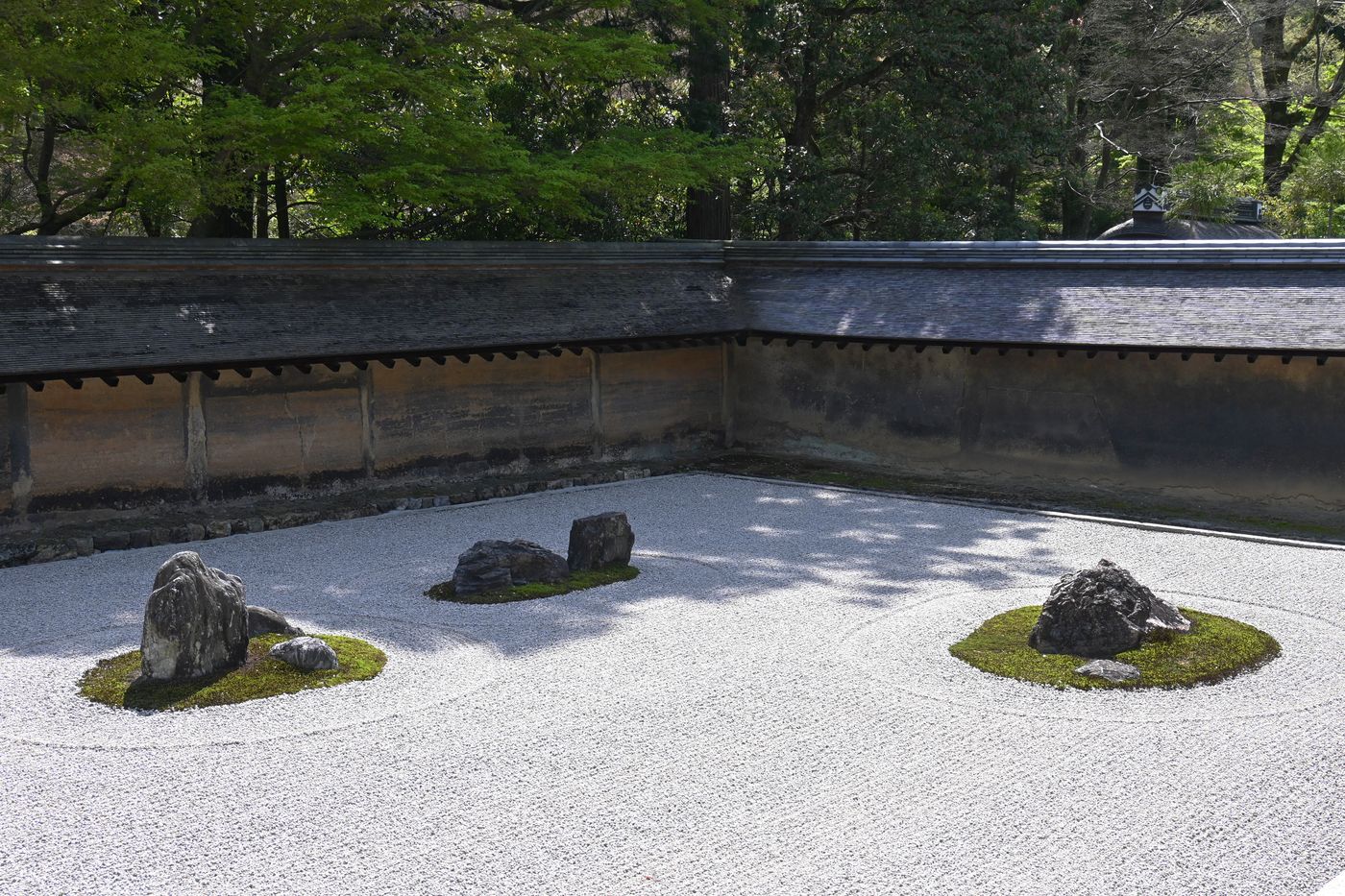
At Ryoan-ji in Kyoto, fifteen stones sit in raked white gravel, viewed from a wooden veranda that seats perhaps a dozen people at once. There is nowhere else to stand. The garden was never built to be walked through — it was built to be read, from exactly one seat.
The seat, not the stroll
A Western garden is often a collection: a rose bed here, a border there, paths that let a visitor wander among specimens and admire each in turn. A Japanese karesansui — the dry landscape garden of raked gravel and stone, most famously at Ryoan-ji — offers no such invitation. There is no path into it. The gravel is raked into lines that represent water; to step onto it would be to walk on the sea. The only way in is with the eye, from a veranda set at a fixed distance and a fixed height, calibrated by whoever built the garden centuries ago.
This is the first thing to understand about these gardens: they are not planted, they are composed. Stone, gravel, moss, and a handful of trained trees stand in for mountain, ocean, and cloud. The garden is a landscape in miniature, arranged the way a painter arranges a canvas — and, like a painting, it has a vantage point the artist had in mind when they made it.
Borrowed scenery
Some gardens extend that composition beyond their own walls. The technique is called shakkei — borrowed scenery — and it is one of the more quietly radical ideas in Japanese design. A hedge is trimmed low at a precise height so that a distant mountain appears to rise directly behind it, as though the peak belonged to the garden itself. A wall stops short of a tree line so that the tree line becomes the wall. At Entsu-ji in northern Kyoto, a clipped hedge frames Mount Hiei on the horizon, folding a mountain several kilometres away into a garden a few dozen paces wide. The visible boundary of the garden and its actual boundary are two different lines, and the gap between them is the whole point.
The logic runs against instinct. A garden, one assumes, ends where its wall does. Shakkei treats the wall as a frame rather than a limit, and borrows whatever lies beyond it — a mountain, a stand of bamboo, even a neighbour's roofline if it is handsome enough — as part of the picture. At the Adachi Museum of Art, the principle is taken further still: the garden is not entered at all. It is viewed only through the museum's windows, each one glazed and positioned like a scroll painting hung on a wall, so that the boundary between architecture and landscape disappears entirely. Whether a visitor ever sets foot in the garden is beside the point. It was built to be looked at, not occupied.
The discipline of restraint
What is notable, walking through any of these gardens, is how little is actually growing in them. Flowers are rare and usually seasonal rather than permanent — a single flowering tree, timed to a few weeks of the year, rather than a bed kept in perpetual bloom. Moss, stone, gravel, and a small number of pruned pines or maples do most of the work. Colour is not the currency. Structure is.
This is a deliberate asceticism. A garden built around seasonal flowers is a garden that changes character completely across the year and can look bare for months at a time. A garden built around stone and structured planting holds its composition in every season, and lets the seasonal elements — a maple in autumn, a plum in late winter — arrive as a change within a fixed frame rather than the whole show. The raked gravel is reworked by hand, the lines redrawn to suggest ripples or currents, precisely because the garden's other elements barely move. It is one of the few art forms maintained daily specifically so that it can look, from a distance, unchanged.
The pruning follows the same logic. A pine is trained for years, sometimes decades, not to grow larger but to be legible — its branches thinned so that the shape of the tree, and the negative space around it, can be read clearly from the viewing seat. What is removed matters as much as what remains. The Japanese word for this negative space, ma, describes the interval itself as a designed element: the gap between stones, the empty gravel between the last rock and the wall, is not unfinished space. It is part of the composition, doing the same work a rest does in a piece of music.
One composition, one moment
Not every Japanese garden asks to be viewed from a single seat. The stroll garden, or kaiyu-shiki, built around the great estates of Kyoto and Okayama, is designed to be walked — but even here, the path is not a wander. It is a sequence, and the sequence is the design. A path curves deliberately around a hill so that a pond appears suddenly rather than gradually; a stone is set at an angle in the path to slow a visitor's pace at the exact point where the view opens out. Kōraku-en in Okayama and the gardens of Kyoto's imperial villas were composed as a series of framed scenes, each one revealed at a calculated moment along the route, the way a hand-scroll painting reveals its landscape as it is unrolled rather than seen all at once.
The difference between the two types is a difference of tempo, not of intent. A karesansui offers one composition, held still, for as long as a visitor is willing to sit with it. A stroll garden offers a sequence of compositions, each one timed. Neither offers open exploration. Both assume a visitor who is prepared to move — or sit — at the garden's pace, not their own.
Why it asks to be sat with
This is where a Japanese garden tends to defeat a hurried visitor. Photographed quickly from the veranda and left after a few minutes, Ryoan-ji's rock garden reads as a curiosity: some stones in gravel, a minor stop between temples. Sat with for twenty minutes, in the quiet hour before a coach arrives, it starts to do the thing it was built to do — the eye moves from stone to stone, along sightlines the designer plotted, and the gravel's raked lines begin to read as motion rather than pattern.
The garden does not reward speed, because it was never built to be consumed quickly. It was built around a single seated view, held for as long as someone is willing to look. That is a demanding thing to ask of a modern itinerary, which tends to allocate a garden the same twenty minutes it gives a shop. It is also, increasingly, the reason these gardens are worth visiting outside the middle of the day, when the veranda is not shared with fifty other people photographing the same fifteen stones from the same angle before moving on.
Why it matters now
A garden built around one seat and one borrowed view is, in effect, a small argument about attention. It assumes a visitor with time to give it — time to notice that the mountain behind the hedge is not incidental, that the gravel was raked that morning, that the empty space beside the last stone is doing work. That assumption sits awkwardly with a travel itinerary built for coverage, where a garden is one stop among a dozen and the measure of a good day is how much of the city was seen.
It sits comfortably, though, with the way these gardens were always meant to be encountered: unhurried, at the hour their designer had in mind, from the seat they were composed for. That is not a lesser way to see a garden. Given how these places were built, it may be the only way to see them at all.
Sources: UNESCO World Heritage Centre, Historic Monuments of Ancient Kyoto: https://whc.unesco.org/. Nippon.com, on Japanese garden design and shakkei: https://www.nippon.com/en/. Japan National Tourism Organization: https://www.jnto.go.jp/.