
On Travelling Beyond
Beyond the Shrines
Toshogu is the reason most people come to Nikko. It is not the reason to stay.
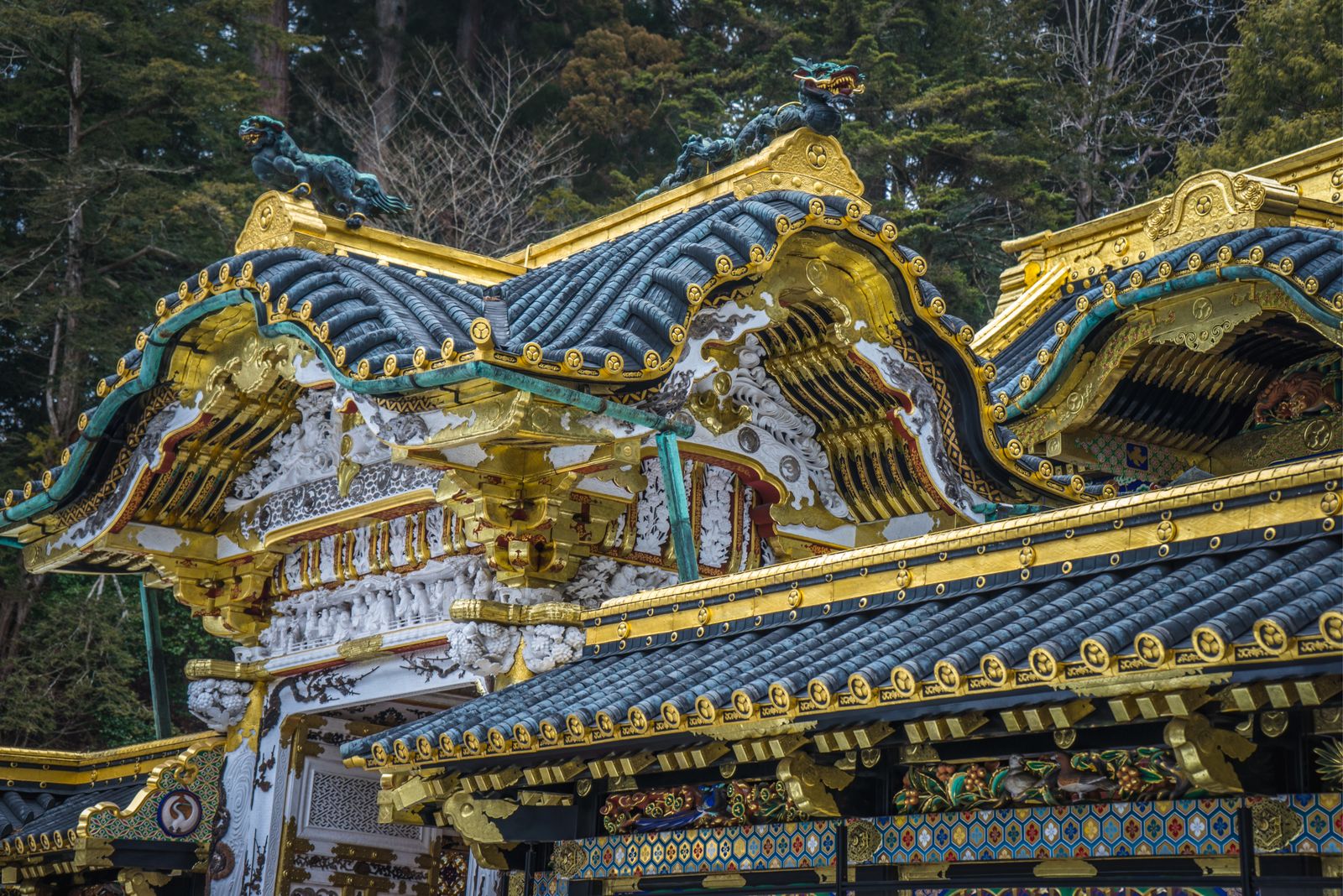
Most visitors to Nikko see one thing: the gilded, carved complex of Toshogu, photographed, checked off, and left behind by early afternoon on the way back to the train. Fewer see what the shrine was built inside of — a mountain, a forest, a lake, and a waterfall that the shrine's own founders considered every bit as sacred as the buildings themselves.
An afternoon that ends too soon
Toshogu earns its reputation. The shrine complex built for Tokugawa Ieyasu's enshrined spirit is a riot of carving and gilt rare in a country whose religious architecture usually prizes restraint: the sleeping cat carved into a transom, the three wise monkeys on the sacred stable, a five-storey pagoda, gold leaf across nearly every surface that will hold it. It is, by design, meant to overwhelm — a display of Edo-period wealth and devotion with almost nothing held back. Most visitors arrive from Tokyo on a day trip, spend two or three hours inside the shrine precinct, and are back on a southbound train by mid-afternoon, having seen exactly what the shrine wanted them to see, and nothing of what surrounds it.
Where the shrine and the mountain are the same idea
That is a shame, because Nikko's own religious logic never separated the buildings from the landscape around them. The site was founded as a place of mountain worship, centred on Mount Nantai, the peak that rises directly behind the shrine precinct and that Nikko's earliest ascetics climbed as an act of devotion rather than recreation. When UNESCO inscribed the Shrines and Temples of Nikko as a World Heritage Site, the citation recognised not merely a set of buildings but their integration with the natural setting around them — the cedar forest, the mountain, the way the architecture was deliberately positioned to complete a landscape rather than interrupt one. Toshogu's gold leaf gets the photographs. The forest it sits inside is the actual argument the site was built to make. It is worth noting, too, that Nikko itself simply means "sunlight" — a name that describes a mountain and a forest at least as readily as it describes a shrine.
A mountain crossed on the backs of snakes
The mountain's religious history begins, according to legend, with a Buddhist monk named Shodo Shonin, who arrived at the raging Daiya River and found no way across. Two great snakes are said to have appeared and formed a bridge of their bodies, letting him reach the far bank and, with it, the mountain he had come to climb. The sacred bridge that spans the river today, the vermilion Shinkyo, is built on the site the legend points to — a small, characteristic detail of how thoroughly Nikko's identity was built from the mountain outward, with the shrines arriving centuries later as an expression of a reverence the place already held.
An avenue, a lake, and a waterfall
Walk or drive a short distance from the shrine precinct and the argument continues in a lower key. An avenue of cryptomeria cedar, planted as a devotional offering to the shrine centuries ago, still lines stretches of the old roads into Nikko — a tunnel of trunks towering overhead, cool and dim even at midday, predating every one of the buildings most visitors came to photograph. Higher up, Lake Chuzenji sits in a caldera shaped by an ancient eruption of Mount Nantai itself, ringed by forest that turns a deep red in autumn. At its edge, Kegon Falls drops in a single unbroken column, ranked among Japan's finest waterfalls and, on most afternoons, seen by a fraction of the crowd that spent its morning at the shrine gate an hour's bus ride below.
A different autumn than Kyoto's
Nikko's elevation gives it a foliage season with its own rhythm, distinct from the temple gardens of Kyoto lower in the basin. The cooler mountain air around Lake Chuzenji typically turns colour before the maples of central Kyoto do, offering a second, and quieter, version of the same autumn most travellers plan an entire trip around. Missing the peak week in one city no longer means missing the season altogether — Nikko's mountain runs, in effect, a few weeks ahead of the calendar most itineraries are built around.
The dispersal Japan's tourism strategy actually needs
Nikko is a useful test case for a wider problem in Japanese tourism. Roughly 70% of inbound visitors currently concentrate in the Tokyo, Osaka, and Nagoya metros, with about three-quarters of overnight stays falling within just five prefectures — a concentration flagged by the World Economic Forum as a structural weakness in how the country absorbs its own tourism boom. Nikko sits barely two hours from central Tokyo by train, holds UNESCO World Heritage status as significant as any shrine in Kyoto, and is, by most measures, considerably less crowded than the capital's better-known day trips. A traveller who spends a single well-planned day beyond the shrine precinct will likely see fewer other visitors at Lake Chuzenji or along the cedar avenue than they saw queuing for one gate in central Kyoto that same morning. Nikko is not a hidden destination in need of discovery. It is a well-known one that most itineraries simply do not allocate enough time to see properly, because a well-marketed morning at Toshogu is treated as the whole visit rather than the entrance to one.
What staying the extra night buys
The travellers who stay past the shrine gates are not chasing something more obscure. They are choosing to see the same site Nikko has always been — architecture and mountain together, not one without the other — rather than the abbreviated version that fits inside a day trip's train schedule. An avenue of centuries-old cedar, a lake formed by the same mountain the shrine was built to honour, a waterfall that most of the morning's crowd never sees: none of it is hidden. It simply asks for a little more time than most itineraries allow, built as a day that includes the mountain, not only the shrine. Toshogu is the reason to come to Nikko. The rest of it is the reason to stay.
Sources — UNESCO World Heritage Centre, World Heritage List: https://whc.unesco.org/en/list/. Japan National Tourism Organization, inbound statistics: https://statistics.jnto.go.jp/en/. World Economic Forum, on the concentration of Japan's inbound tourism: https://www.weforum.org/.