
On Tradition
Ritual, Not Spectacle
What decides a sumo bout takes seconds. What precedes it takes centuries.
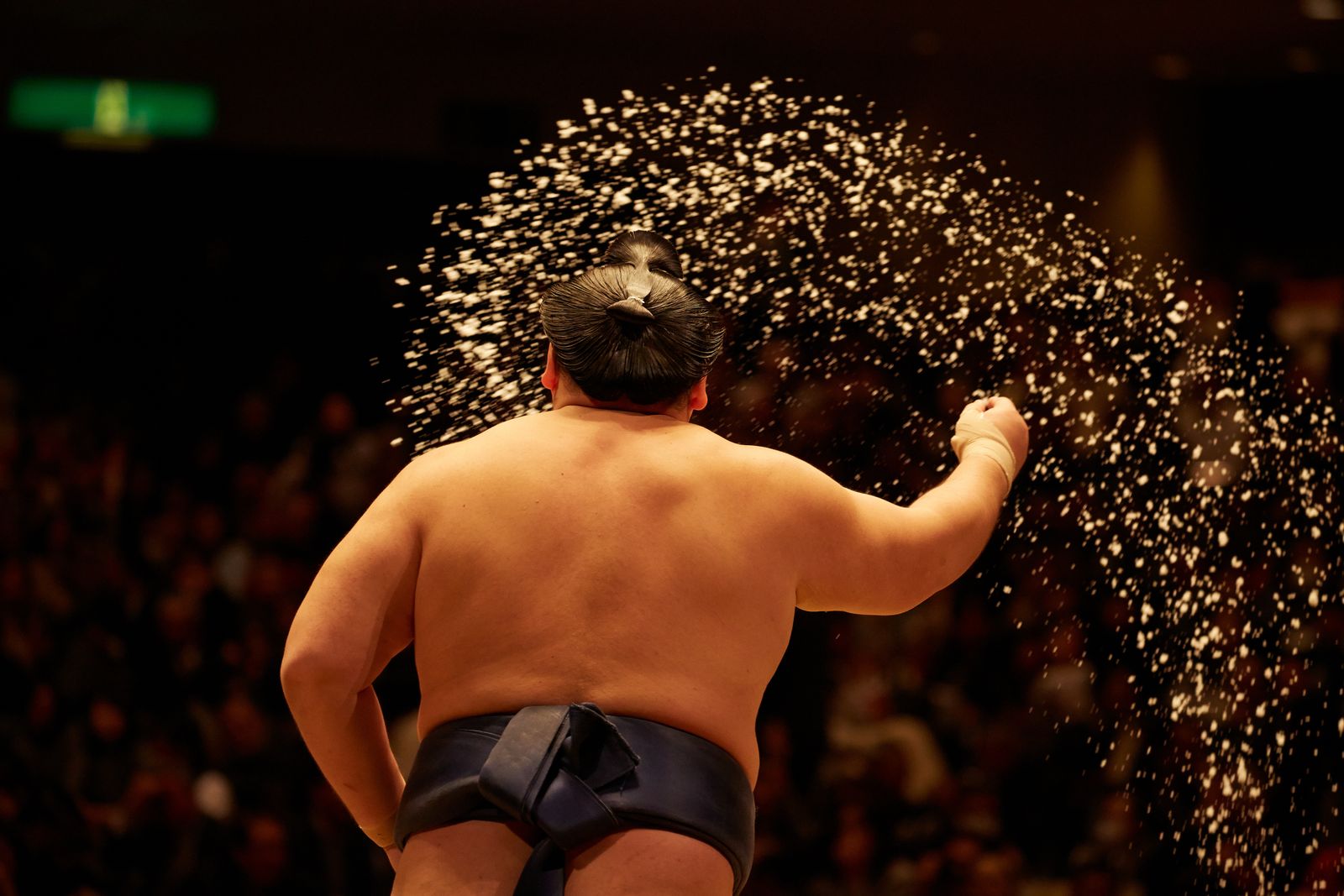
A sumo bout is often decided in the time it takes to read this sentence — a shove, a pivot, a body meeting clay. Watched only for that instant, it looks like an oddly slow sport. Watched for what comes before it, it is something else entirely: a Shinto purification rite, performed in public, that the bout itself merely brings to a close.
The seconds everyone came for
At Tokyo's Ryogoku Kokugikan, a bout between two of sumo's top-division wrestlers can be over before a spectator has finished raising a phone to film it: a clash of full weight, a pivot, one man forced past the straw boundary or down onto the clay. If you had arrived expecting a contest measured like most sports — in minutes, in rounds, in a scoreline — the actual fight can feel almost anticlimactic, a blur sandwiched between long stretches of stamping, squatting, and throwing salt into the air. The stamping alone carries through the hall's wooden rafters like a slow drumbeat, audible even from the cheap seats at the back, long before either wrestler has laid a hand on the other. Many first-time visitors leave with exactly that impression: too much ceremony, too little sport. It is the wrong way to watch it, because the ceremony was never the warm-up. It is the main event, and the bout is its punctuation mark.
Ground that has to be purified before anyone steps on it
The ring itself, the dohyo, is built from clay and rice-straw bales and is treated, before a tournament begins, to a Shinto consecration ceremony in which a priest buries symbolic offerings — rice, salt, dried squid, chestnuts — beneath the surface, sanctifying the ground the wrestlers will fight on for the following fortnight. That sanctity is renewed before every single bout. The handful of salt each wrestler throws across the clay is not showmanship; it is purification, the same gesture used to cleanse ground before a Shinto rite anywhere in Japan. The stamping the wrestlers perform before crouching, shiko, is traditionally described as driving evil spirits out of the ring through the sheer force of a raised leg brought down. None of it is decoration around the contest. It is the ring being made fit, ritually, for what is about to happen on it.
A referee in the robes of a Heian court
The referee, the gyoji, is dressed not like an official but like a court attendant from the Heian period, in silk robes whose colours and patterns are themselves a rank system as elaborate as the wrestlers'. Senior gyoji have historically carried a short sword at their waist — a literal declaration that they would rather end their own life than deliver a wrong verdict, a piece of theatre so severe it makes the stakes of a few seconds of pushing suddenly much clearer. The call itself, when it comes, is delivered with a fan gesture and a set vocal cadence developed over centuries, not a shouted decision. Watching only the bout and missing the gyoji is a little like reading only the final line of a ceremony and calling it the whole text.
A calendar built around six tournaments
Ritual, in sumo, is not confined to a single afternoon. The sport runs on a fixed annual rhythm of six official tournaments, or basho, each lasting fifteen days: three held at Tokyo's Ryogoku Kokugikan and one each in Osaka, Nagoya, and Fukuoka, spaced through the year almost like a liturgical calendar. Wrestlers are promoted and demoted through a strict ranking system, the banzuke, republished after every tournament, so that a wrestler's position in the entrance procession is itself a public record of standing built over years, not a random draw for the day. None of this is visible in a single televised bout, but it is what gives that bout its stakes: a wrestler is not merely trying to win a match, he is trying to hold or improve a rank inside a structure that has run, largely unchanged in form, for centuries.
A ring that is also contested
The dohyo's sacred status is not without its own controversy. Because the ring is treated as consecrated Shinto ground, women have traditionally been barred from stepping onto it at all — a rule that has produced public controversy in Japan itself, including incidents in which medical staff were asked to leave the ring while treating a collapsed spectator. The Japan Sumo Association has defended the practice as a matter of religious tradition rather than gender policy; critics have called it exactly the opposite. Both things can be true of a centuries-old rite continuing inside a modern sport: the same ground that makes sumo more than an athletic contest is the ground some people are still not permitted to stand on. Understanding sumo as ritual does not resolve that tension. It explains where the tension comes from.
What gets lost on a highlight reel
Sumo travels badly onto a phone screen, because almost everything that gives the sport its meaning is the part a highlight clip cuts away. A ten-second video of the clash tells you who won. It cannot show you the ring being made sacred an hour earlier, the wrestlers' rank determining the order in which they are permitted to enter, or the peculiar hush of several thousand people watching a ritual they take seriously enough not to talk over. None of this makes sumo a museum piece rather than a sport — wrestlers train as hard, and are judged as competitively, as athletes in any combat discipline. It only means that judging sumo by the standard of a Western contact sport, decided by force and speed alone, measures the one part of it that was never meant to stand on its own.
Seeing it change what it means
Sumo rewards being there in a way few sports do, because so much of what it is trying to say happens in the minutes a broadcast schedule has no patience for. The salt thrown, the leg raised, the referee's fan held just so — none of it is explained for a foreign audience, because it was never built for one. It is a Shinto ceremony that happens to end, several times an afternoon, in a contest. A day built to explain what you are watching, and not merely where to sit, is the difference between seeing sumo and seeing only its final second. Seen that way, the seconds of the bout stop being the whole point and become what they always were: the moment a much longer ritual finally lets go.
Sources — Japan Sumo Association, on the history and Shinto elements of sumo: https://www.sumo.or.jp/En/. Nippon.com, features on sumo ritual and the role of the gyoji: https://www.nippon.com/en/.