
On Japanese Dining
The Eight-Seat Counter
Japan's finest meals are often served to eight people at a time, on purpose.
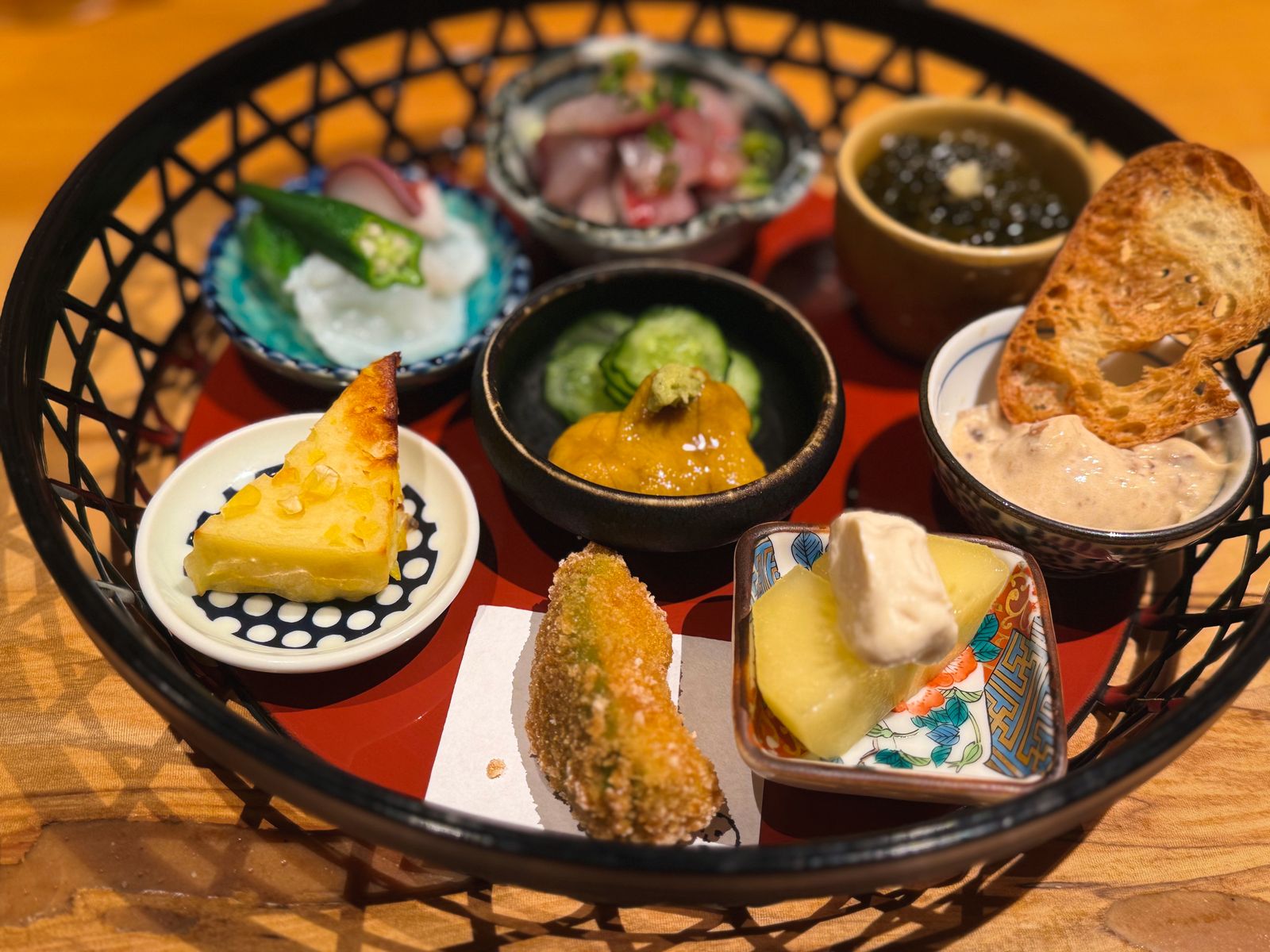
The finest meal you can eat in Japan is often served to no more than eight people at a time, at a wooden counter, by the one person who made it. This is not scarcity manufactured for effect. It is closer to the opposite: a kitchen kept exactly as large as it needs to be to do the work properly, and no larger.
The counter as the whole restaurant
Walk into one of Tokyo's serious sushi restaurants and you will often find the entire business is a single counter: eight or ten stools, a strip of hinoki wood scrubbed pale, and a chef who works the whole service standing directly across from you. There is frequently no printed menu. You are handed what is good that day, in an order the chef has decided, one piece at a time — a practice with its own name, omakase, meaning roughly "I leave it to you." The format is not limited to sushi. Kaiseki, Japan's formal multi-course cuisine, and much of the country's tempura and unagi tradition follow the same logic: a small room, a fixed number of seats, and a cook who can see every plate that leaves the kitchen because there is only one kitchen, and it is in front of you.
This is not a fringe curiosity within Japanese food culture; it is close to the centre of it. Washoku, Japan's traditional dietary culture, was inscribed by UNESCO as an Intangible Cultural Heritage of Humanity in 2013 — an unusual honour for a national cuisine, and a signal of how deliberately the everyday practice of eating is treated as craft rather than mere sustenance. The counter is simply where that craft is most visible, because there is nowhere in the room for it to hide.
Small because the work demands it
The size is not an affectation. A chef working a counter alone, or with one or two apprentices, can only prepare so many pieces of nigiri to the standard the seat beside you just received before the rice cools and the fish loses its temperature. Sourcing imposes its own ceiling: a good sushi counter buys from a small number of trusted dealers at the fish market, often a specific amount of a specific catch that morning, and once it is used there is no substitute delivery arriving at six. Kaiseki works the same arithmetic in a different register — a seasonal ingredient available for a few weeks a year, prepared in the one way that suits it, cannot be scaled to a banquet hall without becoming a different, lesser dish. Smallness, in other words, is not the brand. It is the only structure that lets the food be what it claims to be.
Not the same as luxury
It is easy to mistake this format for something inherently expensive, and in Tokyo's most famous sushi-ya it certainly can be. But the same logic holds at a neighbourhood soba counter or a ten-seat ramen shop where the owner has made the same broth every morning for thirty years, charging a fraction of a kaiseki dinner's price. What both ends of that spectrum share is not a price point but a ceiling on scale: one person, or a very small team, doing one thing to a standard they can personally guarantee. A counter seat at a modest tonkatsu shop and a seat at a three-star sushi-ya are, structurally, the same idea wearing different clothes. Smallness is the constant. Price is a separate variable, decided by what is being sourced, not by how many seats are in the room.
A meeting that happens once
Japanese hospitality has a name for what this smallness produces: 一期一会, ichigo ichie — "one time, one meeting." The phrase comes from the tea ceremony, where a host might spend weeks selecting a single scroll, a single flower, and a single bowl to suit one particular gathering, on the understanding that the same guests, the same season, and the same state of mind will never assemble again in quite that combination. A counter chef works to a faster clock but keeps the same principle: the fish available that morning, the vegetable at its seasonal peak that week, the specific mood of a specific evening's service, are treated as unrepeatable rather than standardised. A counter meal inherits that idea in a more everyday form. The fish, the season, the conversation, the chef's mood that evening — none of it repeats exactly, even for a guest who returns next month and sits on the same stool. That is a very different value proposition from a restaurant that has scaled its signature dish into something reliably identical every night. One sells consistency. The other sells a moment that will not happen twice.
What the stars actually measure
Tokyo has, for well over a decade, held more Michelin stars than any other city in the world — a statistic that says less about extravagance than about density: an unusual concentration of very small kitchens, each doing one thing with total attention, packed into a city built at a human, walkable scale. The guide's own criteria reward exactly the qualities a counter is built to deliver — precision, seasonality, consistency of a very particular kind — rather than scale, spectacle, or square footage. A star, in this context, is closer to a note taken on a small, repeatable act of craft than a verdict on grandeur.
Access, not exclusivity
None of this is really about exclusivity, however it might look from outside. An eight-seat counter is not trying to keep people out; it is trying to keep the work honest, at the only scale the work can be done honestly. The real difference for a traveller is not status but access: whether a seat at that counter comes through a relationship built over years, or is left to chance on a booking page that fills within seconds of opening. Reservations at the best counters are rarely won by persistence alone — they are extended to guests the restaurant already trusts, directly or through someone it trusts in turn, often as part of a day built around that single meal rather than a table squeezed between two others. What a traveller is really paying for, in the end, is not eight seats. It is the chance to be one of the eight.
Sources — Michelin Guide, star criteria and city rankings: https://guide.michelin.com/en. UNESCO Intangible Cultural Heritage Lists, on the inscription of washoku (2013): https://ich.unesco.org/en/lists.